

✨ At a Glance
- Scientists at Goa University in India have developed a nanomaterial for advanced supercapacitors. The material could help devices charge within minutes.
Research from Goa University
Goa is a small state on India’s west coast. It is well known for its beaches and tourism. The state is also home to Goa University, where researchers are developing new energy-storage technologies.
Dr Pranay Morajkar led the research at the university’s School of Chemical Sciences. His students, Diptanshu Pradhan and Sarvesha Shetgaonkar, also worked on the project.
What are supercapacitors?
Supercapacitors store and release electrical energy quickly. They can charge in seconds and handle thousands of charge-discharge cycles. This makes them useful for systems that need short bursts of power.
Supercapacitors work differently from standard batteries. Batteries store energy through chemical reactions. They usually hold more energy, but those reactions make them slower to charge and discharge.
Supercapacitors store less energy than most batteries. However, they can absorb and release power much faster. They can also last through many more charge-discharge cycles.
Where are supercapacitors used?
Supercapacitors already support several real-world applications. Transport systems, industrial equipment and backup systems can use them for rapid bursts of power.
Researchers are also studying their use in smartphones, laptops and electric vehicles. Supercapacitors could also help store energy from renewable sources, including solar power.
How the new material works
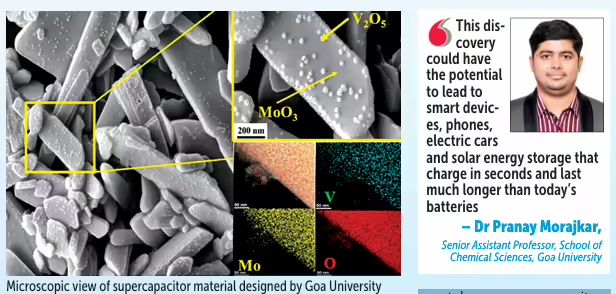
The team created thin, two-dimensional layers of molybdenum oxide (MoO₃). They then decorated the layers with vanadium oxide (V₂O₅).
The researchers engineered tiny atomic “flaws” in the material. These flaws created open pathways for electrical charges. The interfaces between the two metal oxides also improved the material’s electrochemical activity.
Although flaws often suggest weakness, researchers can design and control them. In this case, the engineered flaws helped the material store and release energy more efficiently.
Promising test results
The team built a test energy-storage device with the material. The device stored substantial power and charged quickly. It also maintained its performance after thousands of uses.
The results suggest that engineered atomic flaws can improve supercapacitor performance. This approach could help researchers create more efficient energy-storage devices.
Dr Morajkar said the discovery could support faster-charging phones, smart devices and electric cars. It could also improve energy storage for solar power systems.
Sources:
Latest Posts

SimpleX Chat Crowdfunding: A Chance to Support the Future of Private Messaging

Sensory AI: Why Your Next Robot Might Have a Nose

Most Downloaded Apps in 2026 & The Best Alternatives to Try

2026 Euki Review: Privacy-First Reproductive Health Tracking

2026 Grist Review: The Evolution of Relational Spreadsheets

2026 AliExpress Review: Global Value in a Digital Marketplace

Get Online Security Tips, Guides & News – Straight to your Inbox 📥
By clicking Submit you confirm that you are 16 years of age or older and you agree to our Terms of Use and Privacy Policy. You may unsubscribe at any time.