
Key Takeaway: Submarine cables in the Strait of Hormuz carry 97% of global data traffic. A single act of sabotage could paralyse international finance and trigger a global digital blackout.
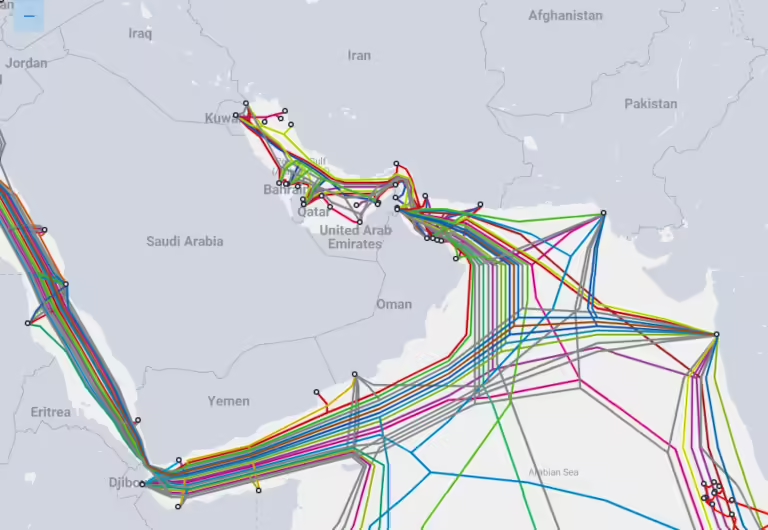
The Strait of Hormuz serves as a critical chokepoint for global data. This narrow passage lies between Iran to the north and the UAE and Oman to the south. It connects the Persian Gulf directly with the Gulf of Oman. At its narrowest point, the Strait spans only 33 kilometres.
The Strait of Hormuz: Global Connectivity at Risk
Deep-sea fibre optic cables carry nearly 97% of all international internet traffic. Consequently, any disruption here would trigger a massive global crisis. The following statistics highlight the scale of this hidden infrastructure:
- Global Internet Traffic: 97% flows through submarine fibre optic cables.
- Active Systems: Over 570 systems globally as of 2025.
- Total Length: More than 1.4 million kilometres of undersea cable.
- Energy Flow: 20% of global oil and 25% of global LNG pass through Hormuz.
Strategic Cable Networks
According to the TeleGeography Submarine Cable Map, several high-capacity systems transit this region. The following table highlights the most significant networks currently in operation:
| Cable System | Route | Significance |
|---|---|---|
| SEA-ME-WE 5 & 6 | SE Asia → Middle East → Europe | Backbone of Asia–Europe traffic |
| AAE-1 | Asia → Africa → Europe | Major India–Europe link |
| FALCON | UAE → Oman → India | Directly transits Gulf waters |
| 2AFRICA | Europe → Africa → Asia | World’s longest cable system |
The Threat of Hybrid Warfare
Sabotage acts represent a dangerous form of hybrid warfare. As noted by the Center for Strategic and International Studies (CSIS), these actions target the very backbone of our digital world. Therefore, a single cut could instantly paralyse international financial systems. These operations fall below the threshold of conventional armed conflict. However, they cause disproportionate strategic damage to global economies.
“The challenge of attribution provides actors with plausible deniability, as deliberate damage can easily be disguised as accidental anchor strikes.”
— Maritime Security Analysis
The IRGC Navy possesses the maritime capability to execute such strikes. Their fleet includes submarines, remotely operated vehicles, and combat divers. These assets can physically cut or damage cables across the Gulf floor. Furthermore, the challenge of attribution provides Iran with plausible deniability. Saboteurs can easily disguise deliberate damage as accidental anchor strikes.
Regional Vulnerabilities
- India (Critical): Relies on Gulf cables for over 70% of international bandwidth.
- Gulf States (Critical): Direct exposure via landing stations and digital economies.
- Western Europe (High): Heavy reliance on Asia–Europe data routes.
- United States (Moderate): Pacific cables partially absorb traffic.

The Double-Shock Scenario
A deliberate attack creates a terrifying double-shock scenario. The Strait simultaneously handles energy supplies and anchors critical digital routes. Consequently, an incident would spike energy prices while destroying digital infrastructure. This dual crisis would paralyse both physical trade and virtual communication.
Global financial markets remain the most vulnerable sector. High-frequency trading and SWIFT transactions require millisecond latency to function correctly. Thus, even minor disruptions could crash international currency markets.
Future Security Priorities
Satellites handle less than 3% of global traffic. Additionally, these systems suffer from much higher latency. Submarine cables carry almost all voice calls and financial transactions. Thus, the world cannot simply switch to space-based internet. According to the International Cable Protection Committee (ICPC), governments must prioritise the safety of this hidden infrastructure now. Security teams are already monitoring these vital underwater routes more closely. Ultimately, protecting these cables ensures the stability of our modern digital life.
Did You Know?
While we often think of the internet as being “in the clouds,” 97% of international data actually travels through cables thinner than a VB tinnie at the bottom of the big blue.

Trending Articles
The Top 5 Privacy Browsers in 2026

2026 Tor Browser Review
2026 Zen Browser Review

2026 DuckDuckGo Browser Review
2026 Mullvad Browser Review
2026 LibreWolf Browser Review


New Deepfake Laws
Many countries are introducing new digital laws to address deepfakes. If you create or share content online, these new rules affect you.
Get Online Security Tips, Guides & Tools – Straight to Your Inbox
By clicking Submit you confirm that you are 16 years of age or older and you agree to our Terms of Use and Privacy Policy. You may unsubscribe at any time.